
Struggling to Upsell Without Feeling Cringy?
If you’ve been stuck in awkward, uncomfortable upselling that either falls flat or makes you want to crawl out of your skin, you’re not alone.
For a long time, I thought the answer was just “trying harder” to upsell—using scripts, pushing specials, and saying all the right lines—because that’s what everyone told me to do. But no matter how much effort I put in, it felt like I was working harder, not smarter.
Guests would nod politely… decline… and I’d walk away feeling like I just tried to sell a timeshare instead of dinner.
Then, I made one simple shift: Instead of focusing on what I was saying, I put my energy into when and why I was saying it (timing and context)—and suddenly, everything started falling into place.
Here’s why this works, how you can make the shift, and what results to expect when you do.
Why Focusing on What to Say Might Be Keeping You Stuck
Many servers believe having the perfect upsell line is the key to success, but in reality, it often leads to:
🚩 Forcing moments that aren’t there – You’re delivering suggestions when guests aren’t ready, so it feels pushy instead of helpful.
🚩 Feeling awkward and inauthentic – Because you are being inauthentic. You’re following a script, not reading the table.
🚩 Missing the real opportunity – You’re focused on talking… instead of paying attention to when guests are actually open to buying.
Example:
“I used to suggest appetizers the second I greeted the table—before they’d even looked at the menu. Shockingly… no one was excited about that.”
The problem isn’t that upselling is wrong—it’s that focusing only on the words ignores the behavior happening right in front of you.
The Power of Shifting to Timing and Context
Instead of pouring your energy into what to say, shifting your focus to timing and context allows you to:
✨ Work smarter, not harder – You’re making suggestions when guests are naturally receptive.
✨ Increase your success rate fast – Same suggestion, better timing = dramatically better results.
✨ Create a system that feels natural – No scripts, no cringe, just smooth, confident interactions.
Example:
“Instead of pitching desserts randomly, I started waiting until I saw guests slow down, lean back, and relax—then I’d casually suggest something. My dessert sales jumped without trying harder.”
This isn’t a small tweak—it’s the difference between selling at people and guiding them through an experience.
How to Shift Your Focus to Timing and Context in 3 Simple Steps
Step 1: Identify What’s Not Working
Before you can improve, you need to see where focusing on what to say is holding you back.
Ask yourself:
✔️ Are guests frequently saying “no thanks” to my suggestions?
✔️ Do I feel awkward or rushed when I try to upsell?
✔️ Am I offering things at the same point every time, regardless of the table?
If yes… you’re not alone. You’re just operating on autopilot timing instead of intentional timing.
Step 2: Shift Your Strategy to Timing and Context
Instead of doubling down on scripts, start focusing on when the guest is ready.
This means:
✔️ Watch behavior first – Are they scanning the menu? Laughing? Settling in? Rushing?
✔️ Match the moment – Suggest appetizers when they’re exploring, drinks when they’re deciding, desserts when they’re winding down
✔️ Make it feel like a natural next step – Not a sales pitch
Examples:
When they’re scanning drinks: “If you like something refreshing, that margarita’s been a hit tonight.”
When they’re hesitating: “Most people pair that with the truffle fries—it’s a solid combo.”
When they’re relaxed post-meal: “If you’re in the mood for something sweet, the cheesecake is hard to beat.”
Notice—you’re not pushing. You’re plugging into the moment.
Step 3: Track Your Progress & Adjust as Needed
Once you make the shift, start paying attention.
✔️ Are guests saying “yes” more often?
✔️ Do interactions feel smoother and more natural?
✔️ Are your tips increasing along with your sales?
If something feels off, adjust your timing—not your personality.
Because this isn’t about being perfect—it’s about being aware and responsive.
What Happens When You Make This Shift?
When you move from what to say to timing and context, you’ll notice:
💡 Less stress – You’re not forcing awkward lines anymore
💡 More momentum – Conversations flow naturally into higher check averages
💡 Better results – Guests say “yes” more often—and tip accordingly
And here’s the best part:
It doesn’t feel like upselling anymore.
It feels like great service.
Want to Go Deeper? Get My Free Guide
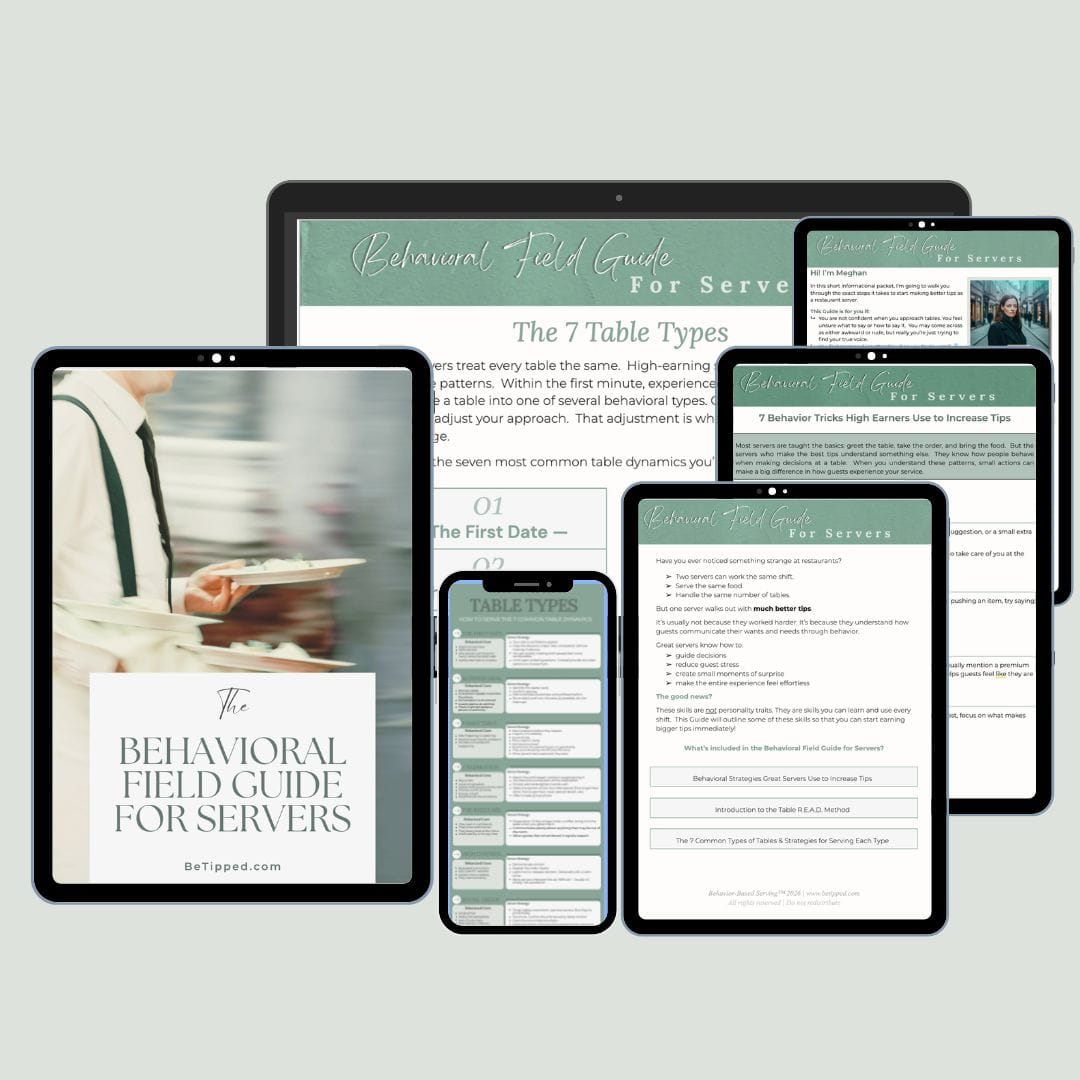
If you’re ready to make this shift without overthinking it mid-shift, I’ve put together a free 9-page PDF: The Behavior Field Guide for Servers.
Inside, I break down:
✅ How to read table behavior in real time—so you know exactly when to act
✅ How to adjust your approach without scripts or guesswork
✅ How to turn small behavioral shifts into bigger tips consistently
👉 Grab it here and start shifting your focus today!
No more awkward upsells. No more guessing what to say.
Just smoother interactions—and way better tips.
FREE DOWNLOAD
Behavioral Field Guide for Servers
Do you want to make better tips? You'll learn the basic strategies that got me to consistently making 25% tips or more. If you are ready to start making better tips, download the free guide today!
© 2026 BeTipped.com