
How to be a Good Coworker as a Restaurant Server
A busy shift can feel like a magic trick gone wrong, full hands, ringing printers, and four tables needing ranch at the same time. In that mess, the best servers do more than handle guests well, they make the whole team stronger.
That matters because good coworker habits lead to smoother shifts, better tips, less stress, and a stronger name in the building. Plenty of server tips focus on sales and side work, but your reputation with the team can make or break every shift after that.
If you want solid Server tips that help you earn trust, swap help without drama, and keep service from turning into a group panic, you're in the right place. Start with the small habits that make coworkers glad you're on the schedule.
Start with the small habits that make people trust you
Trust between servers rarely comes from one heroic save during a slammed dinner rush. It grows in tiny, repeatable moments, the kind people notice without making a speech about it. If you want practical Server tips that actually improve relationships, start with the habits your team sees every shift.
The floor has a long memory. People remember who keeps things moving, who creates extra work, and who acts like basic teamwork deserves a standing ovation. Small habits set the tone, and over time, they tell your coworkers whether they can count on you.
BE ON TIME, BE READY, AND DON'T MAKE YOUR TEAM WAIT
Showing up late doesn't just affect you. It bumps stress onto everyone else, because someone has to cover your section, greet your tables, or pick up the slack while you're still jogging in with your hair on fire. Even being a few minutes behind can start a shift with irritation instead of trust.
Being "on time" also means ready to work, not technically inside the building while still hunting for a pen. Walk in with your tools and your brain switched on. That means your pens, order book, apron, wine key if you need one, and a head clear enough to focus on the room instead of your own scramble.
A reliable start tells your team a few important things:
You respect their time.
You understand that fairness matters.
You won't turn your bad prep into their problem.
First impressions happen every shift, not just on your first day. If the opener sees you clock in ready, or the closer knows you won't vanish during setup, that sticks. On the other hand, if you're always missing something, always frazzled, or always "almost ready," people notice that too.
Reliability is one of the fastest ways to earn trust, because your coworkers don't have to guess what version of you is walking in.
This matters for new and seasoned servers alike. A new hire who shows up prepared often earns respect faster than a veteran who strolls in late and blames traffic. Skill matters, sure, but daily dependability is what makes teamwork feel fair.
DO YOUR SHARE OF SIDE WORK WITHOUT ACTING LIKE IT'S A MAGIC TRICK
Every server notices who rolls silverware, refills the ice, wipes the station, and restocks cups without needing a manager, a reminder, or a search party. Side work is not glamorous, but neither is making your coworkers babysit you. If you quietly handle your part, people trust you more because they don't have to chase you down at the end of the night.
Resentment grows from the little stuff. One person keeps disappearing when it's time to stock sauces, and suddenly everyone remembers. Another person knocks out their side work before being asked, and that gets remembered too. The difference is huge, even if the task itself is small.
Doing your share helps the whole shift run smoother because the basics stay covered. It also changes how people respond when you need help later. Coworkers are much more likely to run food to your table, grab a refill, or back you up in a rush when they know you pull your weight without fanfare.
A good rule is simple: if you see something empty, messy, or low, fix it if it's part of the shared space and you have a minute. That habit pays off fast. It keeps the station from turning into a sad little disaster zone, and it shows you're thinking like part of a team, not a solo act.
You don't need applause for normal responsibilities. In fact, asking for credit every time you restock straws has the same energy as expecting a trophy for tying your shoes. Just do the work well, do it consistently, and let that speak for you.
People trust the server who handles boring tasks without being hunted down, because that person makes the whole shift easier.
That kind of dependability builds real goodwill. And in restaurants, goodwill is worth a lot more than one loud, performative moment of help.
Talk to other servers in a way that keeps the peace
A restaurant floor gets loud fast. Plates clatter, someone needs ranch, table 42 wants the check, and suddenly even normal words can come out with the charm of a smoke alarm. That is why some of the best Server tips have nothing to do with sales or upselling. They are about how you talk to the people beside you when the room is moving at full speed.
Good communication keeps service smooth, but it also keeps resentment from piling up like dirty side plates. Your tone matters as much as your words. If you sound sharp, rushed, or bossy, people feel it right away. If you sound clear and respectful, they are much more likely to help without a side of attitude.
KEEP REQUESTS CLEAR, QUICK, AND RESPECTFUL DURING THE RUSH
When the rush hits, nobody needs a long speech. They need a clean ask, the table number, and a tone that says "we're on the same team." Short and polite wins every time because it saves time and keeps your coworker from feeling ordered around.
A good request sounds like a real person talking, not a tiny dictator in an apron. You can say, "Hey Sam, can you greet table 24 for me? I'm stuck running drinks." Or, "Jess, if you pass by 16, can you drop a refill? I'll grab your soup in a sec." That works because it is direct, specific, and easy to act on. It also tells the other server what you need without making them decode your stress.
A few moments say a lot about you on the floor. These are the kinds of requests people usually respond well to:
"Maria, can you run this food to 31? Thank you."
"Chris, can you greet my new two-top? I'll be right behind you."
"If you're near 12, can you refill their iced tea for me?"
"Nina, can you watch 22 for one minute while I close out 18?"
Names matter more than people admit. Using someone's name gets their attention fast, and it sounds human. "Hey, Taylor" lands a lot better than yelling "Can somebody do this?" into the room like you're summoning a spirit.
Also, say thank you, even during the weeds. It takes one second. Those two words keep requests from sounding like commands, and they remind people that help was a favor, not rent they owed you. If they save your table, your tip, or your sanity, act like you noticed.
One habit causes trouble fast, barking orders across the floor. Nobody likes hearing "I need waters on 14!" shouted from ten feet away while carrying a tray. It puts people on blast, creates confusion, and makes the whole place feel more chaotic. Walk over if you can. If you cannot, keep it calm and pointed: "Alex, when you have a second, I need a greet on 14."
A respectful tone travels farther than a loud voice.
It also helps to match urgency to the moment. A refill is not the same as a table waiting ten minutes for a greet. If it is urgent, say so without sounding panicked. "Can you please greet 21 now? They're waiting on me." That gives useful context. Meanwhile, if it can wait a minute, let it breathe. Not every request needs sirens.
People remember how you sound when you're busy. Anyone can be nice when the dining room is half-empty and the soda gun still works. Real teamwork shows up when you're slammed, sweating, and one dropped ramekin away from losing your religion. That is when calm, respectful words do the heavy lifting.
FIX MIX-UPS FAST INSTEAD OF LETTING THEM TURN INTO DRAMA
Restaurant mix-ups happen because the floor moves fast and humans are not robots. Somebody gets double-seated, two servers think the same table is theirs, or a shared station turns into a game of "who touched my stuff?" The mistake itself is usually small. The trouble starts when nobody addresses it, or someone handles it with heat.
If a mix-up happens, deal with it early and keep it simple. A quick private check-in works better than a public showdown near the drink station. You do not need a courtroom speech. You need a calm sentence and a fix. "Hey, I thought 33 was mine, but maybe I missed the rotation. What happened?" That keeps the door open instead of kicking it off the hinges.
Double-seats are a classic mess. If your coworker gets hit with two tables at once and you can greet one, do it. Later, sort out the section details without acting like you deserve a parade. On the other hand, if you took a table that was not yours by mistake, own it fast. "I grabbed 42 because I thought it was mine. My bad. Want to keep it or switch it back?" That kind of honesty kills drama before it grows legs.
The same goes for wrong table assumptions and shared stations. Maybe you thought the four-top was in your section because they sat near your booth line. Maybe someone used your register, your pens, or your sauces during a rush. Most of the time, it is confusion, not sabotage. Start there. You will save yourself a lot of pointless anger.
A few simple habits help in those moments:
- Keep your voice low and your words plain.
- Stick to what happened, not what you think they meant.
- Admit your part if you added to the mess.
- Fix the table, then sort out the feelings.
Owning your part matters because it makes the other person less likely to get defensive. You do not need to grovel. Just be straight. "I should've checked the chart first." "I didn't realize you already greeted them." "I heard table 10, but I thought you said 12." That is enough.
Tone does a lot of hidden work here. A sentence like "Why did you take my table?" comes in hot. "I thought that was my table, did I miss something?" gives the same issue air to breathe. One starts a fight. The other starts a fix.
Miscommunication is common on a loud shift, especially near expo, the POS, or anywhere a blender is screaming. So if something feels off, check before you assume. Half the time, the problem is noise, timing, or crossed wires. The other half still goes better when you handle it with a level head and a short memory. The table needs service, not a front-row seat to server beef.
Be the coworker people actually want to help
Some of the best Server tips have less to do with sales and more to do with being useful at the right moment. People want to help the server who notices the mess, shares the load, and doesn't act like every inch of the station is private property. That kind of teamwork feels good, but it also pays off on brutal shifts, because help usually comes back around.
Restaurants run on small favors. One refill, one saved greet, one quick table touch can keep someone's whole section from sliding off a cliff. If you build a habit of being aware and generous, your coworkers stop seeing you as extra work and start seeing you as backup.
NOTICE WHEN SOMEONE IS DROWNING, AND JUMP IN FOR A MINUTE
You do not need to rescue a whole section to be helpful. Most of the time, one tiny save is enough to stop the panic from spreading. During peak hours, a one-minute assist can feel like somebody handed over oxygen.
Look for the obvious signs. A server is double-sat, their hands are full, and drinks are dying in the window. Run the drinks. Someone is stuck cashing out a table while another table has finished appetizers and dirty plates are piling up. Prebus the table on your way by. A guest asks for ranch and you know your coworker is trapped at the POS. Grab the ranch and keep moving.
Those little actions matter because the rush stacks fast. One delay turns into three, then the whole section starts wobbling. A quick jump-in keeps service smooth and saves your coworker from that awful "everything is happening at once" spiral.
A few examples make this real:
You see a server weaving through a packed aisle with a tray, so you greet their new two-top and let them know drinks are coming.
Your coworker hasn't stopped moving for ten minutes, so you watch their section while they sprint to the bathroom.
Food is up, expo is glaring, and another server is stuck dropping a check, so you run the plates before they die in the window.
None of this needs a speech after. Just do it, then move on. The best help on the floor is quick, calm, and low-drama.
Small saves carry huge weight during the rush, because they stop minor problems from becoming table-side disasters.
People remember who noticed. They also remember who stared straight at the chaos and somehow found sudden interest in folding napkins. If you're the server who steps in without making it weird, trust builds fast. Then, when your own section catches fire, someone is a lot more likely to run your iced tea, greet your table, or save you from a ticket pileup.
SHARE SPACE, TOOLS, AND TABLES LIKE AN ADULT
Server stations are tiny pressure cookers. You have POS terminals, trays, condiment caddies, ice bins, drink wells, and six people trying to do twelve things in a patch of floor the size of a bath mat. If you get territorial in that space, tension shows up fast.
Nobody likes the server who blocks the POS while scrolling through checks, hoards trays like winter is coming, or guards the ice bin as if they mined it by hand. The same goes for claiming every condiment caddy near your section or acting offended when someone borrows a terminal for thirty seconds. Shared tools are shared tools.
Courtesy in tight spaces is pretty simple, but people forget it when the room gets loud. A few habits keep the station from turning into a contact sport:
Restack trays and put caddies back where everyone can find them.
Scoop ice and move, don't park your body in front of the whole bin.
If you borrow something, return it fast and in usable shape.
When a table mix-up happens, sort it out calmly instead of planting a flag.
The same rule applies to shared table help. If you greet a table for someone, do not act like you adopted it. If you drop a refill or prebuss a plate, that does not make the section yours now. Help should lower stress, not start a custody battle over table 31.
Good shared-space manners are basic respect with sneakers on. Say "behind" and "excuse me." Give people room to pivot. Do not spread your slips, straws, pens, and emotional damage across the whole station. If somebody needs in, make in possible.
This is where a lot of solid Server tips live, in the unglamorous moments near the POS and the ice bin. When you act like an adult in shared spaces, your coworkers relax around you. That matters. People help the server who makes the shift easier, not the one who treats the station like a tiny kingdom.
This is where a lot of solid Server tips live, in the unglamorous moments near the POS and the ice bin.
Build the kind of reputation people want on their shift
In restaurants, people remember patterns. They remember who vanishes when the host stand backs up. They remember who runs food without acting like they deserve a medal. They also remember who stays calm when the dining room starts to look like a circus with aprons.
A good coworker is reliable in boring moments and useful in messy ones. That's the whole deal. If people trust you, they help you faster, speak to you with more respect, and want you on the floor with them again.
PULL YOUR WEIGHT BEFORE ANYONE HAS TO ASK
The easiest way to become a solid teammate is also the least glamorous. Show up on time. Be stocked. Know your section. Start your shift ready to move instead of wandering around like you just woke up in the walk-in.
That doesn't mean acting like a hero. It means handling the basics so other people don't have to carry you. Refill ice if it's low. Restock straws when you notice the bin is nearly empty. If the expo window is stacked, run a plate, even if it isn't yours.
Servers who only care about their own section create traffic jams. The floor works better when everyone treats the restaurant like shared space. Your table may be your problem, but the shift belongs to all of you.
Small habits speak loudly here. Pre-bus your tables. Keep side work moving. Close loops with support staff. If a busser helps you turn a table fast, say thank you. If a host seats you hard three times in a row, stay polite and talk clearly instead of snapping.
People want coworkers who reduce chaos, not add glitter to it.
COMMUNICATE EARLY, BECAUSE SILENCE CREATES BIGGER MESSES
Restaurants run on quick, plain talk. Long speeches are useless when food is dying in the window and table 42 wants separate checks. Good coworkers keep each other in the loop before problems grow teeth.
If you're behind, say it. If a table has a severe allergy, tell the expo and kitchen clearly. If you're taking a quick water break and need someone to watch your section, ask directly. Most shift drama starts when someone assumes another person "probably knows."
If you say "I got it," make sure you actually got it.
Clear communication also means dropping the mystery act. Don't disappear after saying you'll grab bread. Don't tell a coworker you'll run their drinks and then forget. When your word gets shaky, trust goes with it.
Tone matters too. You can be direct without sounding sharp. "Can you greet my table while I cash out 12?" works. So does "I need two minutes, then I'll take that side work." Clear, calm, and short beats dramatic every time.
A restaurant floor is loud enough already. Your job is to make things clearer, not noisier.
BE COACHABLE, OWN MISTAKES, AND FIX THEM FAST
Every server misses something. A side of mayo gets forgotten. A modifier gets punched in wrong. A refill takes too long because three other things hit at once. Mistakes happen, and nobody wins an award for pretending otherwise.
What matters is what you do next. If a manager or coworker gives feedback, don't throw up a wall. Listen. Fix it. Move on. Defensiveness wastes time, and time is expensive at 7:15 on a Friday.
Owning a mistake can be simple. "I forgot that side, I'll get it now." "That was my miss." "I rang it wrong, but I already asked the kitchen to refire it." Those lines build trust fast because they tell people you're honest and useful.
Excuses do the opposite. Nobody wants to hear a long story about how the printer jammed, table 31 asked for lemons, and the moon was in a bad mood. People want the fix.
This habit also keeps resentment low. Coworkers get frustrated when they have to clean up the same person's mess over and over. But they'll usually give grace to someone who owns the error and handles it right away.
Being coachable doesn't make you weak. It makes you easier to work with, and that matters more than ego on the floor.
MAKE NEW HIRES FEEL WELCOME, BECAUSE EVERYONE WAS NEW ONCE
Every restaurant has its own strange little map. Table numbers make no sense. The ranch lives in a spot nobody would guess. Guests ask for a side plate, and somehow that means three side plates and a spoon. New hires don't know any of that yet.
You can help without turning into a speech machine. Show them where the coffee filters are. Point out the fastest route to the patio. Mention which tables always split checks. Tell them the common guest requests before the rush hits.
Those tiny heads-ups save time for everyone. They also help new servers settle in faster, which means fewer mistakes, less panic, and less pressure on the team. A strong culture doesn't come from a staff meeting poster. It comes from people being decent in real time.
There's also a selfish reason to help, and it's a good one. Today's new hire might be your closer next month. If you teach them well now, your future self gets a better shift later.
Nobody forgets the person who made their first week less brutal. Restaurants can be rough on beginners. A little kindness goes a long way, especially when the ticket machine starts singing like it's possessed.
Conclusion
Guests notice polished service, but coworkers notice who makes the shift lighter when the weeds get waist-high. That's the difference between being fine at the job and being someone people trust.
Be the server who shows up ready, speaks clearly, owns mistakes, and helps the new person find the ketchup ramekins without a scavenger hunt. Reliable beats flashy every time, and on a hard shift, that's the coworker everyone wants beside them.
Most servers were never taught how much team dynamics affect income. The good news? Once you understand it, everything gets easier. I break it all down inside my $19 ebook, The 25% Tip Strategy.
👉 Grab it here before your next shift.
No more feeling like it’s you vs. everyone else.
Just smoother shifts, stronger support… and way better tips.
FREE DOWNLOAD
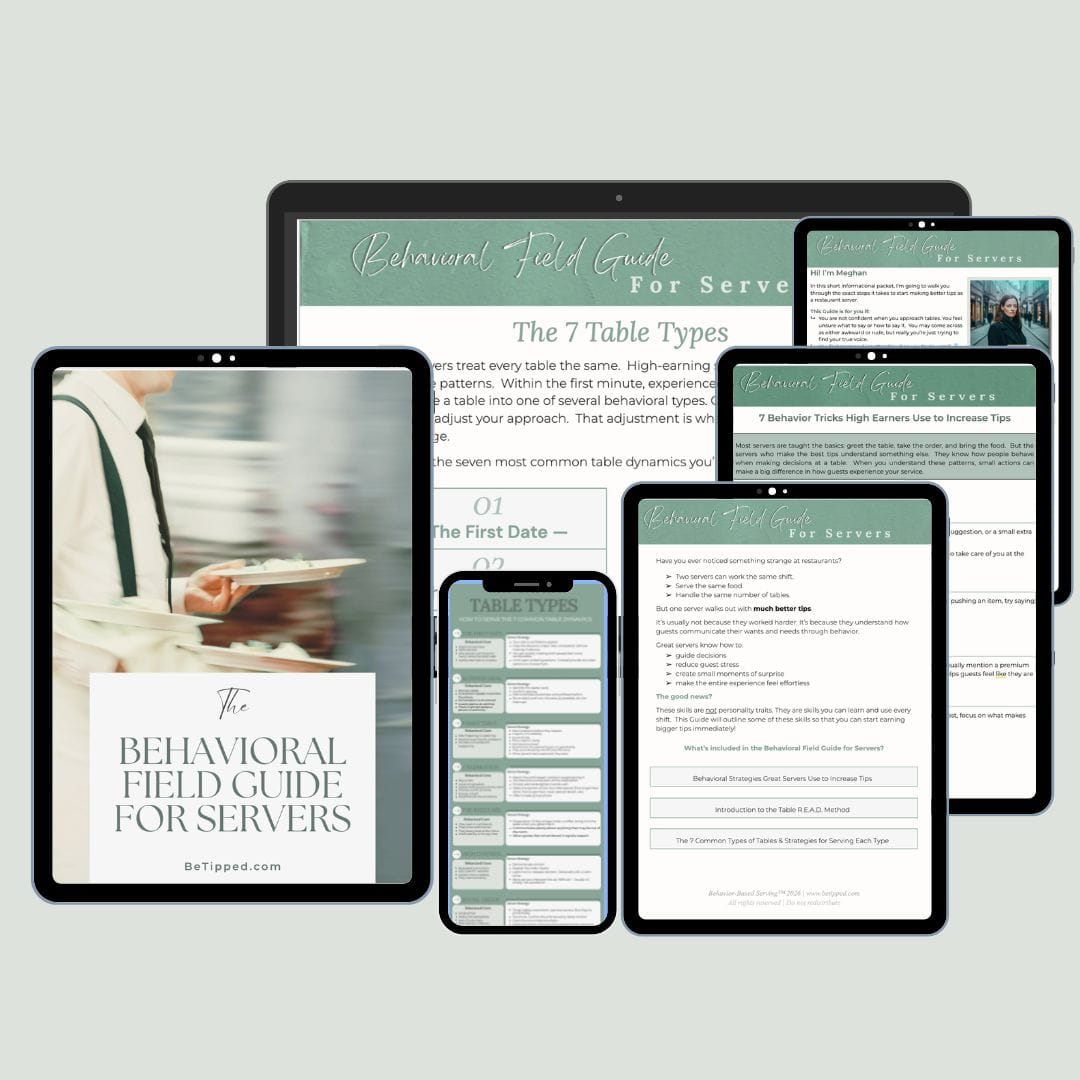
Behavioral Field Guide for Servers
Do you want to make better tips? You'll learn the basic strategies that got me to consistently making 25% tips or more. If you are ready to start making better tips, download the free guide today!
© 2026 BeTipped.com